The short version: walk slower than feels natural, let your feet set the pace, and every time your mind runs ahead to the end of the trail, come back to the next step. Use the views as resting points rather than destinations. Bring water, and go early.
The Southern Ridges is a chain of hills, parks and walkways that links several green spaces in the south of Singapore, with elevated boardwalks through the forest canopy and bridges high above the roads. I go there when sitting still is not working for me. It is close enough to the city to reach on a weekday morning, and far enough above it to feel like a different place.
The first time I walked it properly, I went to train. I was preparing for a hill run and treated the Ridges as a set of slopes to get through as fast as I could. Halfway along the Forest Walk I stopped to catch my breath, and only then noticed where I was: level with the treetops, a pair of birds calling back and forth somewhere above me, the city sounding very far away. I remember feeling slightly embarrassed that I had run past all of it. I have walked it slowly ever since.
The short version
Walk slower than feels natural
A pace that feels almost too slow is usually the one where I start to notice things.
Use the views as pauses, not finish lines
I stop at each lookout for three breaths, then carry on without rushing to the next one.
Go early and carry water
The morning is cooler and quieter. Mindfulness includes looking after your body in the heat.
Why walking works when sitting doesn’t
There are days when I sit down to meditate and my body simply will not settle. My legs feel restless, my thoughts race, and ten minutes on the cushion becomes ten minutes of willing the timer to finish. On those days, walking is often the kinder option.
Walking meditation gives restless energy somewhere to go. Every step offers something concrete to pay attention to: the lift of the foot, the shift of weight, the contact with the ground. When the mind wanders, there is always the next step to come back to. I have found that it is much easier to be present when I am moving than when I am trying hard to be still.
A trail like the Southern Ridges helps too. The route is clear, so I do not have to think about where I am going. The surroundings change slowly, from forest to bridge to hilltop, and that gentle variety keeps my attention without pulling it away.
Where to start
There are several ways onto the Southern Ridges, and the full route is long enough that I rarely do all of it in one go. Many people start near Mount Faber, close to HarbourFront MRT, or from the Kent Ridge end near Pasir Panjang. Choosing one short stretch and walking it slowly is better than marching the whole thing to say you have done it.
My usual route starts at HortPark, about fifteen minutes on foot from Labrador Park MRT, or from Haw Par Villa MRT if I am coming from the west. I aim to begin around 7am, cross Alexandra Arch, follow the Forest Walk up to Telok Blangah Hill, and finish at Henderson Waves. At a slow pace, with stops, it takes me about an hour and a half. If I have more time and energy, I carry on up Mount Faber and come down towards HarbourFront MRT.
Before I set off, I stand still at the start for a minute. I feel my feet in my shoes, notice the temperature of the air and how my body feels after the journey there. I set a simple intention: to walk this stretch with attention, not to reach the end quickly.
The practice, stage by stage
On the first stretch, I bring my attention to my feet. I notice the heel touching down, the roll through to the toes, the push off the ground. On the boardwalks the surface changes underfoot, and I let that be interesting: the slight give of the planks, the sound my steps make, the rhythm that settles in after a few minutes.
Once my pace feels steady, I widen my attention to sound. The forest canopy is full of it: birdsong, insects, leaves moving, the occasional distant hum of traffic below. I try not to name the birds or judge which sounds are pleasant. I just let them arrive and fade, the same way I do with sounds on the MRT.
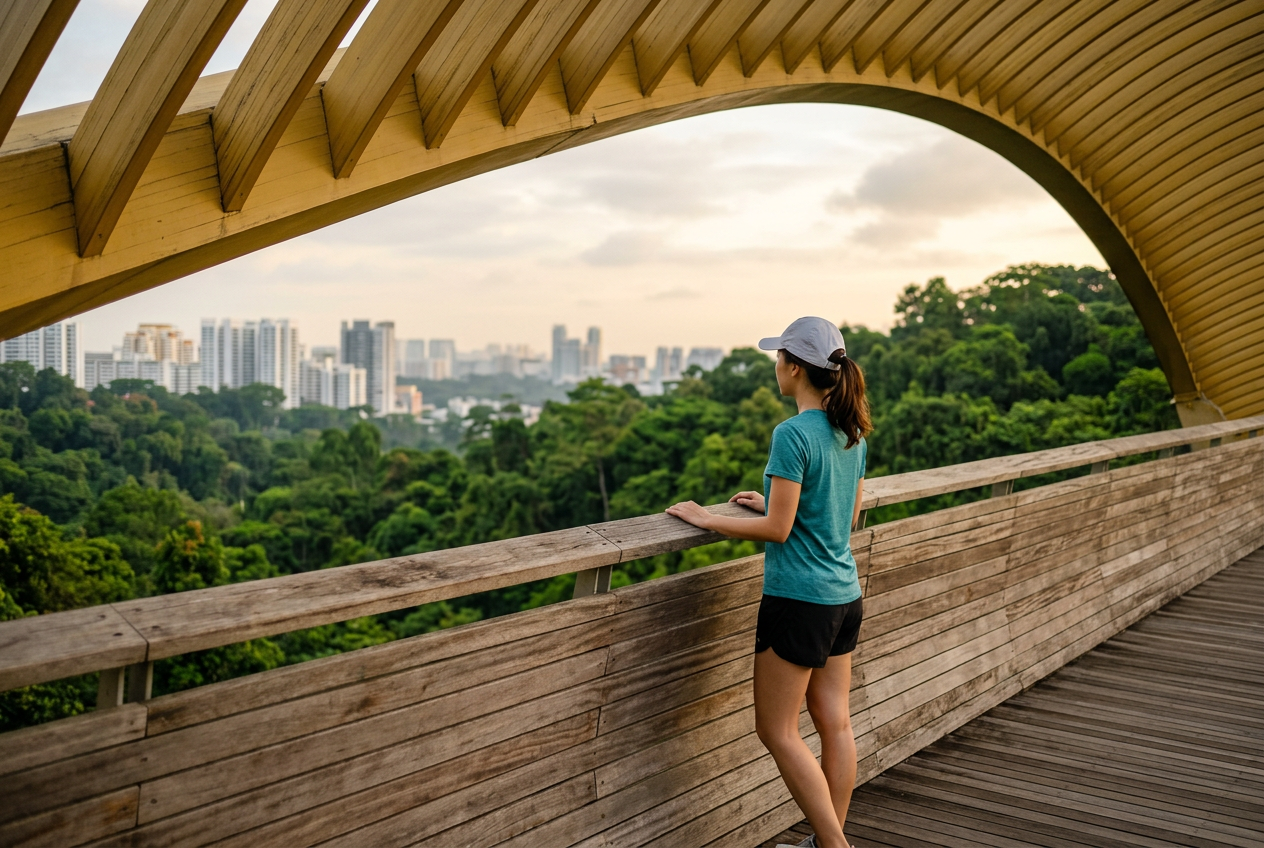
Henderson Waves, the curved wooden bridge high above the road, is where I usually stop for longest. I stand at the rail, feel my hands on the wood, and let my eyes rest on the view: the treetops, the city in the distance, the sky. Three slow breaths. Then I notice the urge to take a photo, and sometimes I give in to it, and that is fine too.
Three slow breaths at the rail of Henderson Waves.
I make a few other stopping points along the way: a shaded bench, a lookout, a spot where the trees open up. At each one I pause, check in with my body and breath, and walk on. These small stops break the walk into short sections, and each section becomes its own small practice.
One morning on the Forest Walk, a long-tailed macaque sat on the railing a few metres ahead of me, completely unbothered, eating something it had found. I stopped, kept my distance and kept my hands and bag close, and we simply looked at each other for a while. I had been carrying a work worry all the way from the MRT, and in those few seconds it disappeared. When it came back later, it felt smaller. Nothing about the problem had changed. I had just remembered how big the world around it was.
When the mind wanders (or the joggers overtake you)
My mind wanders constantly on these walks. I start planning lunch, replaying a conversation, composing a message. Every time I notice, I come back to the next step. Noticing that I have wandered is not a failure. It is the moment the practice actually happens.
The Southern Ridges is popular, so you will share it with joggers, families, dog walkers and groups chatting loudly. Being overtaken by someone running at speed while you walk at half pace can make you feel faintly ridiculous. I treat that feeling as part of the practice too. I notice it, keep to one side so others can pass, and return to my own pace. Being mindful of the people around you is part of walking well in a shared space.
Practical notes
Heat is the main thing to plan for. I go early in the morning, ideally soon after sunrise, when it is cooler, the light is soft and the trail is quieter. Late afternoon can work too, but afternoon storms are common at certain times of year, so I keep an eye on the weather.
I bring more water than I think I need, wear comfortable shoes with some grip for wet boardwalks, and dress in light, breathable clothes. A hat and sunscreen help on the exposed stretches. If I start to feel dizzy or overheated, I stop in the shade, drink and rest. Paying attention to your body includes listening when it asks you to slow down or stop.
Leave the earphones in your bag if you can. The sounds of the forest are half of the practice.
Bringing it home
Not every week allows for a morning on the Southern Ridges, so I keep a five-minute version for ordinary days. I walk slowly around my own block or along a nearby park connector, feeling my feet for the first minute, listening for the second, and looking around for the third. For the last two, I just walk and notice whatever comes.
It is not the same as walking above the treetops, but the practice is the same: one step, then the next, with your full attention. Over time I have found that the calm I feel on the Ridges is not really stored up there. It comes from the way I walk, and I can bring that anywhere.
Reflections to carry
Pausing at a lookout halfway through a long walk
You are not on your way to anywhere. This step, this view, this breath is the whole walk.
Write your own moment of stillness
Tell us where your feet are taking you today, and let one line walk alongside you.
Linked for reference and general education only. Mindfulness Reflections is not affiliated with these organisations, and their guidance is not a substitute for care from a qualified professional.